

On Staying Grounded
… and Vital and Whole

Dear Friends,
I write to you from Vermont. I have been reading Mary Oliver in the mornings while looking out a window at New England trees. They are blazing with beauty, before they shed their leaves for winter and nurture roots for the spring. I can’t help but wonder, as she often did, what they would say to us if they could — what they would teach us.
This past summer, on Cortes Island in British Columbia, I had the great honor of standing in a forest with Suzanne Simard. You may remember her revelatory conversation with me in 2021. She grew up in a family of foresters and loggers and eventually became a forest ecologist who has utterly shifted our understanding of trees and the vitality of the natural world. Modern forestry saw a forest, like a human group, as a collection of individuals. Simply put, it focused on what the human eye could see looking up and — at a less conscious level, perhaps — applied a logic of Western society. It assumed that trees compete with each other for light and soil. It routinely tore out mature trees to plant marketable, young species, alone and set apart.
On Cortes, Suzanne trained my vision and imagination down to the ground, where features of the natural world that we’re only now taking seriously are stitching the life of the forest and the life of the planet together: mycelia, fungi, mosses. It turns out that a forest is a single organism wired for reciprocity and mutuality. The oldest hub trees — which she calls Mother Trees — are incessantly sensing “who is rich and who is poor, who is healthy and who is sick.” They communicate, send warning signals, and deliver nutrients — you can hear this with a Geiger counter — by way of carbon and nitrogen and phosphorus and water and chemicals and hormones. One of Suzanne’s most astonishing findings is that these networks of communication and sustenance closely mirror what we’re now able to see in the neural networks of the human brain.
I’m letting all of this enliven my understanding of what it means to stay grounded and vital and whole in this time. For this too is the generative story of our time: We’re on dazzling, revolutionary territory of seeing the workings of vitality inside the body of the Earth and inside ourselves. We’re understanding that we’ve inhabited ecosystems while organizing the modern world around specialization, categorization, mechanization, and the individual. We’ve inhabited ecosystems, that is to say, while organizing around parts.
Even modern Western medicine grew up in love with specialization and became largely an art of treating our parts. But the ecosystem of our own bodies may be the most surprising new territory of all. Here, too, we’re seeing pathways and infrastructure that bring the whole into concert, for better and for worse, that we did not know how to take seriously before: vagus nerve, stress response, microbiome, fascia, interstitium. My body and yours are teeming at any given moment with more non-human than human cells, our well-being at all times dependent on all manner of bacteria. A new word in biology is “endosymbiosis,” describing a phenomenon found everywhere in nature in which the cells of one organism live and thrive inside the cells of another, to mutual benefit. The endosymbiotic microbiome in the gut of a human being regulates digestion, the absorption of nutrition, and the warding off of disease in communication with the brain and the whole of the body. Some are calling it a new “organ” of the body. Some are calling it “the second brain.” It may be, in ways we keep unlocking, the very epicenter of quality of health and of life.
Our life together too is endosymbiotic — or wants to be — which goes some way in explaining our communal dysregulation in a very different light than the one cast by politics and technology. You are a stranger to me. And: Our lives are in kinship. It is not just that my well-being and yours are at some very real level bound up together if we look closely enough at our economies and societies and ecologies. We may resist this knowledge and live in lonely and unhealthy defiance of it. Nevertheless, we are joined at all times by the substance of our beings — the energy and matter of our bodies, the air we breathe, the ground we stand on, and the mysterious stuff of consciousness itself — and this is as much common sense as high science.
“Do you think there is anything,” asked Mary Oliver, “not attached by its unbreakable cord to everything else?”
It might seem like a quiet, even too gentle, response to say that part of being a generative — and, as nature would teach us, regenerative — force in this time is to cleave to such a truth and live, as John Lewis counseled, “as if” this were already realized, doing what I can to make its common sense more visible to more people. The reality of vitality itself will not let me live according to the illusion that separation is our nature or that we are alone in our anguish and our desire to rise to a higher humanity and flourish together with others across every fault line and fracture that defines our life together now.
I hope that the whole archive of On Being and this newsletter and this community of kinship can be a place where you feel that as a possibility. We will produce a new season of On Being shows early in the new year, and I will keep sharing with you here what I am seeing and pondering. In the meantime, I continue to be out in the world with events – which is to say, with people in their bodies. We’ll have details to share soon about January happenings in Boston and Los Angeles. There are a two public events coming up shortly in New York City, to which you are warmly invited — one where I’ll be interviewed, the other a live taping of On Being. Details and ticket info are below. I’d be so happy to see you there.
With love,
Krista
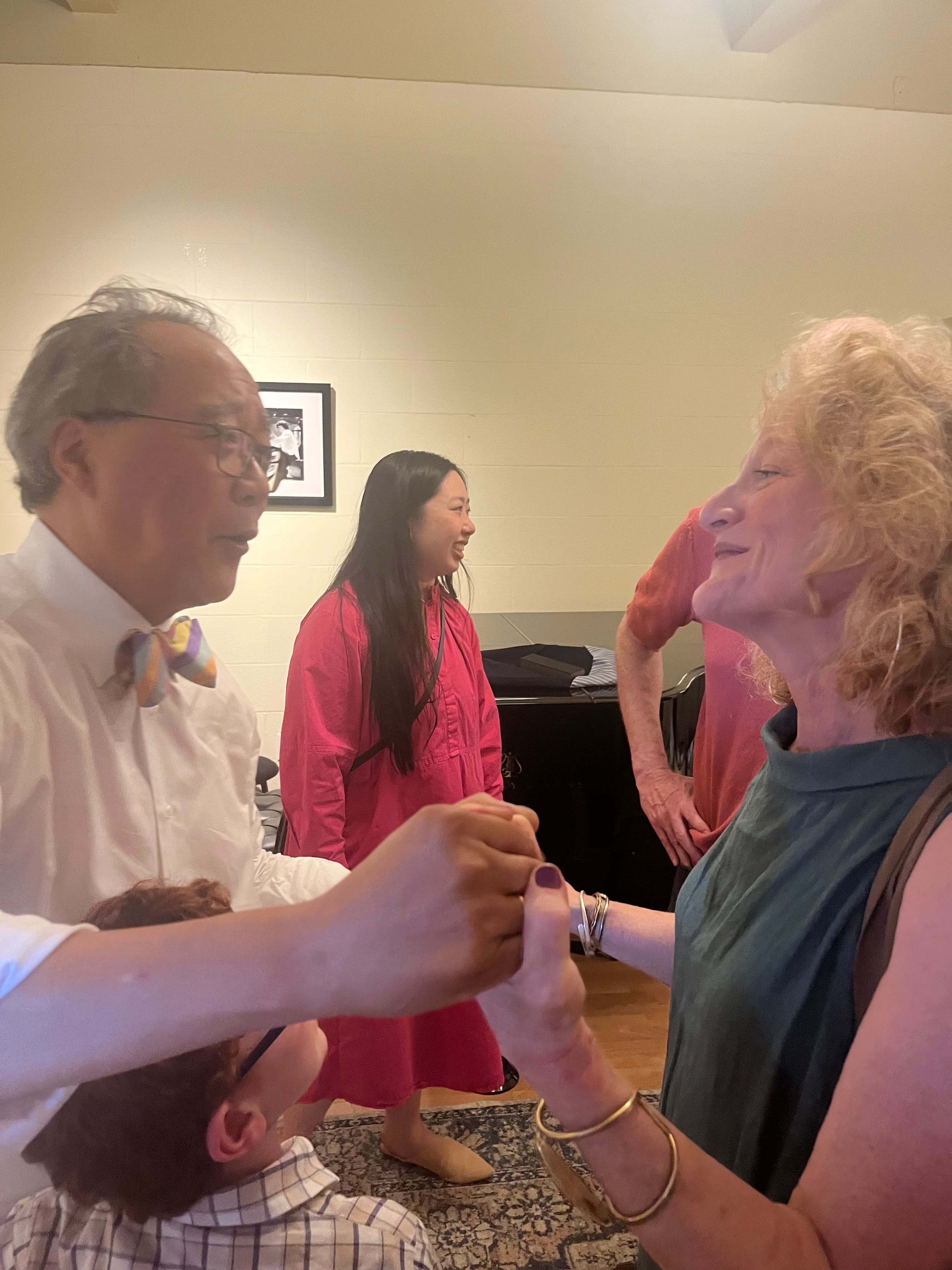
P.S. The photo above was snapped this summer at Tanglewood, where I met Yo-Yo Ma in the old-fashioned flesh for the first time. He is a member of this far-flung On Being community and it was, as you can see, a lovely moment.
In the World

Attend:
New York City, Tuesday, November 11, 7:30 p.m. Krista will be interviewed by Rabbi David Ingber of the famous 92nd Street Y. They’ll explore listening as a form of presence, the evolution of public discourse, and the sacred possibilities of everyday life. Purchase Tickets Here.
New York City, Thursday, December 4, 7 p.m. On Being Live: Krista with Joy Harjo and Tracy K. Smith at the Peter Jay Sharp Theatre at Symphony Space. Two former Poet Laureates and beloved On Being guests, both with new books! Purchase Tickets Here
Listen:
Poetry Unbound Returns in December!
A new season is underway and is slated to launch in early December and run through the winter. ICYMI, Padraig published two new books this year — 44 Poems On Being with Each Other and Kitchen Hymns. Find them on our Bookshop page, and subscribe to Pádraig’s newsletter Poetry Unbound to stay in touch with his reflections and adventures.
 | A guest post by
|
Wonderful to think of our times as enriched by this learning of inter-connectedness(which intuitively seems to be what the indigenous already knew). What salve and balm. Thank you
I agree with James Sullivan, below, Krista, you are a miracle... of hope and thoughtfulness. Never more enriching or necessary than in this moment. Thank you!