

On Our Lives with AI
What is it calling us to?

Dear Friends,
This is a long missive about a vast subject: our lives with AI. It is the only Pause for this summer. I am in need, it seems, of shoulder surgery. This is not a catastrophic injury or procedure — though it felt that way to me at first! But there will be a significant recovery time. I also intend, in these months, to complete my new book, which has been long in the making, as you know. I’m very close now, and that is exciting.
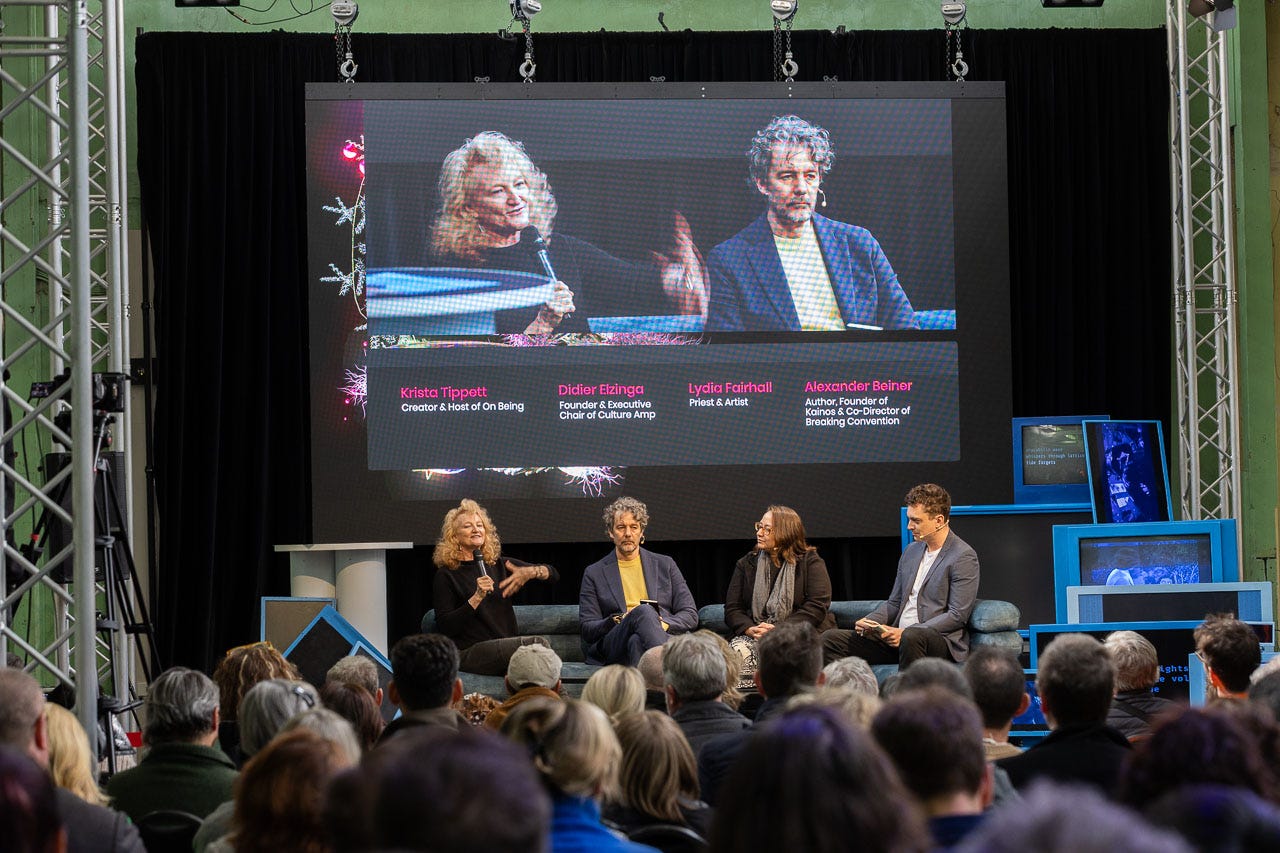
So, in May, as I mentioned in the last Pause, I traveled to Australia for three weeks. I had a few adventures in that fascinating country. The highlight and primary destination was a very special conference — a Wisdom & Action Forum on “Trust in the Age of AI” — convened by Small Giants, an organization I revere led by two people I am grateful to know as friends: Berry Liberman and Danny Almagor.
It is difficult to be even marginally tuned in to the news right now and not feel one’s head spinning from the acceleration of AI technologies and the increasingly outsized imprint on our world of the companies bringing it to us. This conference was refreshingly grounding. It was holistic. The technological/economic “arms race,” as it’s being jarringly called, was in view, but not centered in the way I think it is reflexively centered in AI conversations in the US. The very real dangers of this technological revolution were on the table. But all of that was held with a curiosity as sweeping as this technology demands of us, and with an eye, too, to the generative possibilities it holds for the human and planetary future.
If you listened to my recent conversation with Michael Pollan, you will have heard him describe this time to be alive as a new “Copernican moment” — as when we learned that the sun does not revolve around the earth rather than the other way around, and when we grasped that we are descended from the natural world and not separate from and superior to it. In Australia, I gained an even deeper clarity of what that means in the context of this moment: we humans will no longer be the most intelligent force on the planet. The definition of “intelligent” is key both to the power of AI, as I’ll explore here, and to the deepened self-understanding to which I believe it is calling humanity. But this much is clear: unlike humanity’s previous technological advances, AI is more than a tool. It has agency, the dimensions and meanings of which are unfolding in ways mysterious to its makers. Radically differently from other technological revolutions, this one will co-create the future with us.
As I ponder this age of accelerating tectonic shifts, I endeavor to stand with clear eyes before its perils — and with equal reverence to attend to the questions I am being given to live. The oldest parts of the human brain have forever kept us safe by inclining us to look vigilantly for what might go wrong in any circumstance. Without dismissing the value of this impulse, I am pondering what the advent of our AI is calling me to — what it is calling humanity to, collectively. This is a way to activate the vast and mysterious power of human imagination and agency.
What we in this early century call Artificial Intelligence is a student of us. It is a mirror on us. When we marvel at AI, we are marveling at ourselves. When we fear it, we are fearing ourselves. It is in its infancy, and so is our comprehension of what we’ve made and our grappling with its possibilities. I’m reminded of Einstein’s observation, as he lamented the invention of weapons of mass destruction, that science in his age was “as dangerous as a razor in the hands of a child of three.”
You could say the same, reasonably, of technology in our age. Yet at the very same time, it is bringing new magnitudes of healing possibility into the world that are ours to make real. This is a civilizational moment to put our highest creativity and moral imagination and our most vigorous words and enterprise to the human capacity to shape our technologies to human purpose and to delve how they are inviting and compelling us to learn and to grow.
Some of that growth, I believe, will be in humility. The panel I most enjoyed participating in at the Australia conference traversed AI and What It Means to be Human. You can access a playlist from the forum here. As the conference opened, I engaged Tristan Harris of the Center for Humane Technology in a Zoom conversation. I drew him out on something he says in a new film about AI (The AI Doc: Or How I Became an Apocaloptimist), that the best-case scenario for AI’s evolution will require humanity to rise to its “most mature self.” That is not the description most of us would give to the current state of the human and planetary self. But it does urgently, for me, point back to the matter of calling.
A stark reality that I’ve been grappling with in my writing is this: we have not organized the modern Western world around what makes for a more mature human self and society. Modernity, as people like biomimicry founder Janine Benyus and the evolutionary biologist David Sloan Wilson have brought home to me across the years, is imbued with a simplistic and false understanding of Darwin’s explanation of us. We have internalized and organized around survival of the “fittest,” and implicitly the “smartest,” by a woefully narrow definition. We have neglected what science now sees as the foundational human superpower — of cooperation and collaboration — that has in fact always powered our species’ advance. We have not tended to the whole nature of reality which is becoming ever more demonstrable in this age: a web of interactivity, entanglement, and mutual dependency, as much energy as matter.
What if our technologies are calling us to nothing less than a greater understanding of the deepest meaning and purpose of human intelligence? The modern Western world has revered our cognitive, rational, computational capacities, and demeaned and demoted much of what makes life worth living. Now, these miracles we’ve engineered are, paradoxically, dissolving the illusion that the computing capacities of our big brains are the most special thing about us, or the most superior. The intelligence we bring to living as whole, mature human beings on this Earth are as embodied as they are cognitive.
What if AI is here to bring us literally back to our senses?
After the conference ended, in a joyous public event in Melbourne, Berry Liberman interviewed me on this and other themes I’m holding in my heart and mind in this time. You have heard me say that we are living with distressed nervous systems at a species level, and this makes it hard for us to approach the magnitude of change upon us even with curiosity. I am persuaded that none of us — across our spectrums of health, wealth, identity, or conviction — has a sense of certainty about the future we’re moving towards. A summer of dangerous heat is again bringing home the disarray of the ground beneath our feet and the air we breathe. The loud and repetitive mantra that AI is going to “change everything” only increases uncertainty all around. And uncertainty lands in human bodies as fear.
But the stories we are telling at any given moment, about anything, are the stories we are walking into. Our lives with AI add a wild spin to that, as I learned in a fascinating meeting — equal parts sobering and inspiring — with a wise and impressive person from Anthropic, Chloe Lubinski: the AI models now in their infancy are observing, listening, and taking in the stories we are telling about them. It is hard to fully metabolize the reality that the human mind has given birth to them, that we are in some sense parents, or could act like parents, to entities already wielding so much power. But I have not been able to let go of this knowledge of our creations, at this civilizational juncture, integrating the stories we are telling about them into the world we will co-create with them. It would be like telling a “child of three” every morning how terrible they are, how much worse they will surely grow up to be. It would be like providing them with manuals for the worst-case scenarios of their development, in riveting, vivid detail.
I’m so happy that we can share all the links to the videos from the Australia event, so you can partake and join this broader reflection with me. It is a lived, breathed conversation we will likely be in, in some form, for the rest of our lives. To be clear: there is much here that is cheering. I expected to hear about advances in health care and medical imaging. I did not know that this technology is also enhancing weather prediction in ways that become near-miraculous gifts to farmers in India, who have lived forever with the monsoon as mystery and now have a way to plan around and through it. One of the most hopeful panels I attended was with people working in ecology — rewilding, conservation, protection, and revitalization of endangered species. AI has become an incredible companion for some of their work.
I encourage you too to watch the video here of a conversation with Audrey Tang, who was the first Digital Minister of Taiwan, and who is using digital media with young people in beautiful and visionary ways to inculcate “civic care” and emotional health. There is also an immensely impressive presentation with the eSafety Commissioner of Australia who has just put the world’s first “age gate” for the use of social media in place. What she and her colleagues are learning is providing a blueprint for other countries around the world.
It is intriguing, humbling, and energizing to me — infusing the shape of my sense of calling for the time ahead — that the questions that have animated On Being since the turn of this century are rising up as urgent and tangibly relevant as ever before. What does it mean to be human, fully? How do we want to live? And who will we be to each other? Everything we keep learning about the natural world and the cosmos and our bodies bespeaks the bedrock truth of our belonging to each other. We must dream and create our lives with technology to strengthen, not fracture, this.
Full disclosure: I have my bad days and weeks of despair, too, before our present and possible futures. This early summer has been hard for me. Yet, I’m also actively holding my embodied memory of living in divided Berlin in my 20s through the world transforming beyond where our imaginations could reach. I’m keeping my mind’s eye, emboldened by my life of conversation with science and ecology, on the image of the chrysalis in nature: a state of hidden, frenzied becoming.
I hope this far-flung On Being community feels something like accompaniment on your hard days — a knowledge that you are not alone in daring to face the vaster meaning of all of this. It is an honor to accompany you in the tenderness of what it is to be alive in this generation. And accompany each other we must. As quiet as that sounds, it is a necessary foundation for us to rise individually and communally to that now-elusive state of our “most mature selves.”
Love,
Krista
P.S. I commend to you a special podcast series on the energetic realities and intelligence of our bodies and how Western science is now learning to take this seriously. Phenomena: The Science & Stories of Energy Healing is created and hosted by my friend and longtime member of the On Being community, Ivy Ross, who is also, as it happens, an executive at Google.
Absolutely one of the most disappointing and heartbreaking things I could have woken up and read this morning.
At a time when our home, earth, is literally burning due to global warming, wise intelligent homo sapiens, with real intelligence, are telling us that it is very likely this planet will be uninhabitable by the end of the century. This is easy information to find.
The only thing that can slow this, not stop , is to stop burning fossil fuels and accept as a species that there are limits to our growth. This is also easy information to find.
AI is nothing but the theft of intellectual property and a massive energy and natural resource use and extraction to support the physical structure to house it.
To underestimate the cruel and authoritarian uses this technology can be and is being used for and the damage it will do to civil society (see Palantir) and the planet is beyond naïve.
I am heartbroken to read this. You have been a beacon and a light, but you have surely lost the way here.
I appreciate the intention of staying optimistic and providing a different perspective and light, as you usually do, on a topic that tends to steer so dark. But I cannot get behind the idea of IA knowing the devastating effects of its use. This feels like trying to speak kindly on the benefits of a weapon.